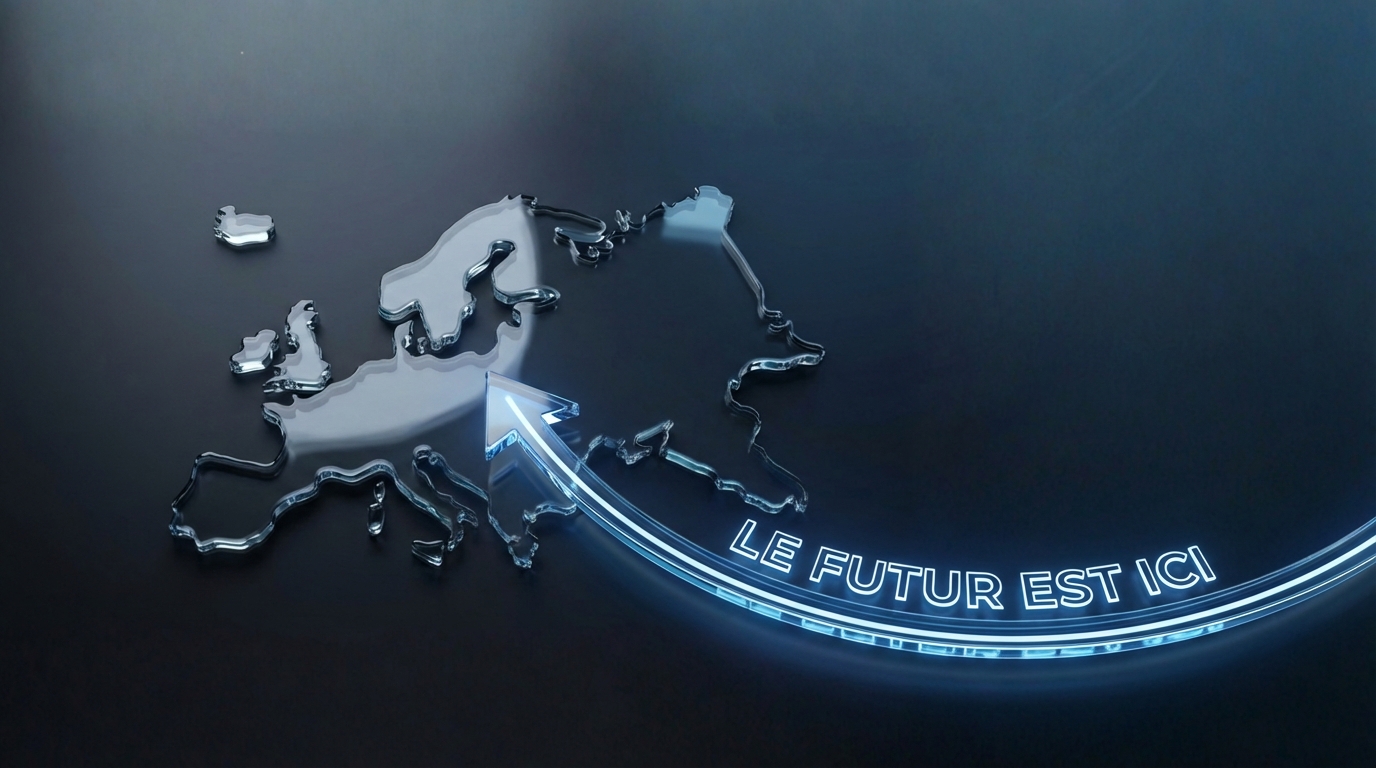
Europe is lagging behind technologically... and that's not necessarily a problem
Europe has lost several major technological battles.
Social networks, smartphones, e-commerce, and now mainstream AI are dominated by the United States and China.
No European Google.
No Meta.
No ByteDance.
Objectively, Europe is lagging behind.
But to confuse tactical delay and strategic defeat would be a major mistake.
Because while attention is focused on Silicon Valley, another dynamic is being built — more discreet, slower, but potentially much more structuring for the next 10 years.
The observation is clear: Europe has a real problem in consumer tech
Before talking about opportunity, you have to be honest about the diagnosis.
An almost total absence of mainstream champions
Europe does not dominate any of the major consumer-oriented technology markets:
- no global social network
- no marketplace capable of competing with Amazon
- a mainstream AI (Mistral) that is still marginal in terms of notoriety compared to ChatGPT
In addition, there is a massive imbalance in investments:
- Silicon Valley rises up to 10 times more Of capital
- China is injecting massive public money into its champions
- For its part, Europe regulates, debates and advances more slowly
A cultural and structural problem
The European delay is not only financial. It is also cultural:
- preference for stability over risk
- Valuing permanent contracts more than entrepreneurship
- innovation often hampered by regulatory fragmentation
Yes, Europe is lagging behind. And it is real.
But that's not the whole story.
What Europe is really building (and few people are watching)
When you stop comparing Europe to Silicon Valley on your own land, another landscape appears.
400 billion euros per year invested in R&D
Europe invests around 400 billion euros per year in research and development, i.e. close to 19% of global private R&D.
And that figure has been growing steadily for over 10 years.
The difference?
This R&D is not oriented towards applications with high user engagement, but towards disruptive technologies.
The quantum revolution: an underestimated strategic advantage
Simply understand the quantum
A typical computer works with binary states: 0 or 1.
A quantum computer, on the other hand, can explore several states simultaneously.
Where a classical computer tests millions of possibilities one after the other, quantum technology explores them in parallel.
Concrete and critical use cases
- Health : drastic acceleration of the discovery of new drugs
- Energy : real-time optimization of complex electrical networks
- Cybersecurity : questioning all current encryption systems
And Europe is on the front line
Contrary to popular belief, Europe is one of the most advanced territories in quantum technology:
- several quantum chip factories under construction
- secure quantum networks on a European scale
- quantum computers already available in the cloud for businesses
While some people are optimizing recommendation algorithms, Europe is building the computers of the future.
Deeptech: Europe's strategic weapon
What is deeptech?
Deeptech is based on:
- 5 to 15 years of research
- laboratories, patents, heavy infrastructures
- extremely high entry barriers
Batteries, nuclear fusion, space, semiconductors, scientific AI.
Why it is a sustainable competitive advantage
An application can be copied in a few months.
Deeptech technology requires years of accumulated know-how.
This is precisely where Europe excels.
European champions already in place
- Mistral AI : sovereign and European AI
- Isar Aerospace : autonomous access to space
- Pasqal, IQM, Quantum Motion : quantum leaders
These businesses are not going viral.
They build technological autonomy.
Why is this strategy becoming critical today
The world is changing phases.
End of the “attention & data” cycle
For 20 years, tech has been dominated by:
- The capture of attention
- data monetization
- rapid growth at all costs
Today, the priorities are different:
- clean energy
- digital sovereignty
- resilience of infrastructures
- technological ethics
European regulatory power as a lever
Europe does not dominate the platforms, but it dominates the rules:
- The GDPR has transformed global practices
- The AI Act imposes new standards on AI
With 450 million consumers, Europe remains the most structuring rich market in the world.
Selling in Europe means respecting its rules.
The next 10 years: a historic opportunity
A favorable geopolitical context
- China aging and more closed
- Unstable and polarized United States
- global need for reliability and the long term
It is precisely the natural terrain of Europe.
Another definition of victory
Europe will never be Silicon Valley.
And it's not a failure.
It can become:
- The world leader in green tech
- The world's digital safe
- The reference deeptech hub
- The ethical compass of technology
Conclusion: lucid optimism
Europe is slow. Fragmented. Careful.
But it also has unique strengths:
- a massive and constant investment in R&D
- recognized scientific excellence
- global normative power
- a long-term vision that has become strategic
Europe will not win by copying others.
She can win in Building something else.
Less spectacular.
Slower.
But sustainable.
And in the volatile world to come, that may be just what we need.
%20(715%20x%20260%20px)%20(1).png)
.svg)