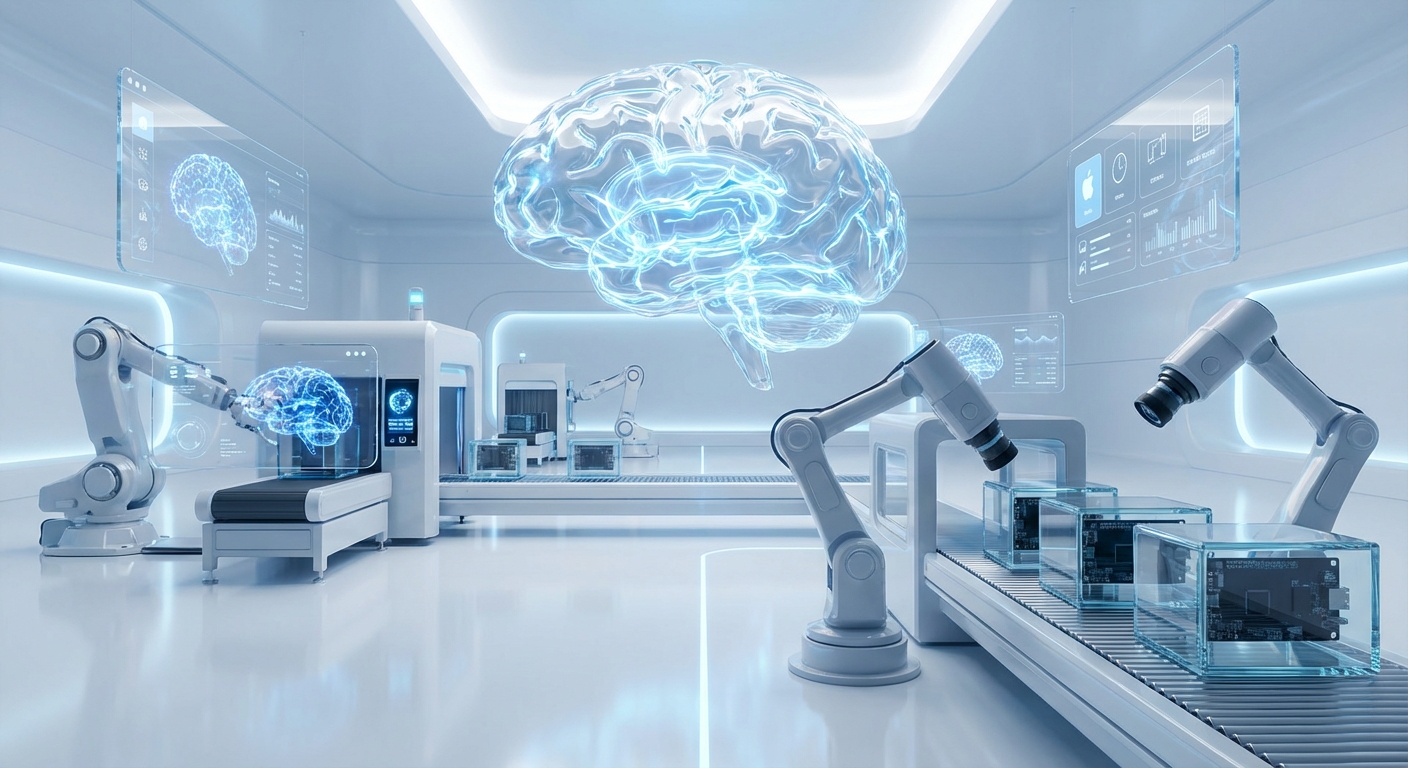
When we talk aboutAI in the food industry, we often think of “futuristic” things: robots, autonomous factories, generative AI everywhere...
In reality, The best AI projects in agro SMEs are much simpler.
They have 3 characteristics:
- They solve a problem Business (margin, costs, compliance)
- They are integrated into reality: ERP, Excel, MES, sensors
- They are Adopted by the teams (quality, production, supply)
And above all: in 80% of cases, The hardest part is not AIis to connect data and industrialize the solution.
Why is AI becoming essential in the food industry?
Agro SMEs face the same challenges as large groups, but with less room for manoeuvre:
- margins under pressure (energy, raw materials, transport)
- ever stronger quality and traceability requirements
- high variability (seasonality, volumes, suppliers)
- dispersed data (ERP, Excel, sensors, quality, production)
- decisions made too late
And this is precisely where AI (and data) becomes a lever:
Turning scattered data into quick decisions.
Spoiler: in agro, it's not “just AI”
Most of the articles ranting about “Food AI” sell an illusion:
“Put on some AI and everything will be fine.”
The reality is more pragmatic:
AI is only valuable if it is integrated into business software, connected to your tools (ERP, MES, sensors...), and aligned with your processes (quality, production, supply chain, maintenance).
That's why the best approach is often:
Data + automation + custom software + AI where it counts.
The 5 agri-food AI use cases that generate the most ROI in SMEs
1) Automated quality control (cameras + AI)
The ground problem
In many agro SMEs, quality control is still based on:
- manual inspections
- Samples
- End-of-line controls
Result:
- It's long and expensive
- It varies according to the operators
- and above all... defects are often detected too late (so scraps, non-conformities, customer returns).
What does AI do in practice
AI does not “replace” the quality team.
It is used to:
- check continuously (instead of a one-off check)
- automatically detect defects (shape, color, presence, labeling, packaging...)
- Trace each lot with visual evidence
What data/hardware is needed
- industrial cameras (often already present or easy to add)
- a few hundreds/thousands of images to train a model
- quality decision rules (what is compliant/not compliant)
Typical ROI
It is an extremely profitable use case because it directly affects:
- The margin
- Non-quality
- The cost of control
Stratia example:
- — 70% manual control
- — 35% scrap
- — 40% of non-conformities
The trap to avoid
The classic trap: doing an “AI POC” on a PC... and never succeeding in integrating it on the line.
The value is in:
- integration
- traceability
- and the quality workflow.
2) Factory dashboard + real-time control (TRS, micro-stops, bottlenecks)
The ground problem
A lot of factories have data:
But these data are:
- scattered
- illegible
- and above all unusable in real time.
The result: teams react too late, and “invisible” losses accumulate (micro-shutdowns, underperformance, speed losses).
What data + AI is (really) doing here
This use case is interesting because it is not necessarily “AI” at the beginning.
The first step (often the most profitable):
- connect the sources
- build a clear dashboard
- standardize indicators
Then the AI comes in the second layer:
- automatic anomaly detection
- smart alerts
- recommendations
Typical ROI
Stratia example:
- +11% in TRS
- — 35% reaction time
- — 20% invisible losses
The trap to avoid
Make a “pretty” dashboard but:
- without reliable data
- without real-time frequency
- without land use.
A good agro dashboard is an operational decision tool, not a PowerPoint.
3) Sales forecasting + inventory optimization (seasonality, materials, shortages)
The ground problem
In agriculture, demand is rarely stable.
It depends on:
- Seasons
- Cultures
- Of the regions
- Commodity prices
- customer behaviors
Many SMEs are still driving with:
- The raw history
- and field intuition
What generates:
- overstocks (cash + DLC losses)
- breakdowns (CA loss + penalties).
What does AI do in practice
AI makes it possible to build forecasts:
- by product
- by period
- by region/channel
- with external variables (if available)
Then to deduce:
- procurement recommendations
- Stock thresholds
- Breakup alerts
Typical ROI
Stratia example:
- — 25% overstocks
- — 20% of breakages
- +8% in turnover
The trap to avoid
Make a perfect “mathematical” forecast... but one that cannot be actioned by the supply/purchasing teams.
The value is not in the curve, it is in:
- The decision
- The alert
- ERP integration.
4) Early detection of process drifts (quality, material losses, stability)
The ground problem
In agriculture, processes are constantly deriving:
- variable raw materials
- wetness
- temperature
- Machine wear
- change of supplier
And often, we realize this:
- When quality falls
- When garbage explodes
- or when a customer complains
So it's too late.
What does AI do in practice
This use case consists of:
- analyze process signals continuously (temperatures, pressures, cycle times, consumption, etc.)
- Learn what is “normal”
- detect anomalies/drifts before they become expensive
The aim is not to “predict everything.”
The aim is to trigger a field action at the right time.
Typical ROI
- reduction of waste/material losses
- stability, quality
- reduction of non-conformities
- saving diagnostic time
The trap to avoid
Wanting a perfect model from the start.
In industry, an alert that is 70% reliable can already generate a lot of value if:
- It is well calibrated
- and that it arrives at the right time.
5) Document automation + compliance (IFS, BRC, audits, traceability)
The ground problem
Compliance in agro is a subject:
But above all: a huge subject of time.
Between:
- The audits
- The controls
- traceability
- quality documents
- the evidence to be produced
Teams spend a lot of time looking for, consolidating and verifying.
What does AI do in practice
Here, AI is mostly useful via:
- automatic document extraction
- intelligent search (NLP)
- synthesis generation
- verification of requirements
And combined with software, it allows:
- To centralize evidence
- to find a document instantly
- to standardize compliance
Typical ROI
- Audit time reduction
- reduction of stress/errors
- reducing non-compliance risks
The trap to avoid
Buy a “generic quality” tool that does not fit your processes.
Tailor-made is often more effective here, because compliance depends enormously on the reality of the business.
How to choose the right use case (without making mistakes)
In SMEs, the best strategy is:
Priority 1: margin (scrap, losses, non-quality)
➡️ AI quality control
➡️ process drifts
➡️ parameter optimization
Priority 2: control (TRS, real time)
➡️ factory dashboard
➡️ alerts and anomalies
Priority 3: cash (stocks, shortages)
➡️ sales + supply forecast
Why it often crashes in SMEs (and how to avoid failure)
AI projects rarely fail for “technical” reasons.
They fail because:
- the data is scattered (ERP, Excel, sensors...)
- Nobody has time to frame
- The project is too ambitious
- the solution is not adopted
And that's exactly why you need a method.
The method that works: framing → prototyping → industrializing
The StratiA method is very suitable for agro SMEs:
- Framing : objectives, needs, scope, ROI
- Functional model in 10 days : validate the value before investing
- Ongoing development : deliver in an agile manner, integrate, train
It's an “industrial” approach, not a “startup gadget.”
FAQ — Agri-food AI (SMEs)
How much does AI in the food industry cost?
It depends on the use case and the level of integration.
But in SMEs, you can start intelligently via a framework + prototype.
Do I already need an MES?
No
Many SMEs have an ERP + Excel + a few sensors. This is enough to start with several cases.
Is AI replacing quality teams?
No
It reduces the repetitive load, increases traceability, and allows the quality team to focus on real issues.
What is the best use case to start with?
Most often:
- automated quality control
- Real-time factory dashboard
- sales/inventory forecast
Because the ROI is fast and visible.
Conclusion: agri-food AI is a driver of competitiveness (if it is concrete)
AI in the food industry is not a gimmick.
It is a way of:
- stabilize the quality
- reduce losses
- improve factory performance
- better manage the supply chain
But only if it is integrated into real tools, at the service of the business.
%20(715%20x%20260%20px)%20(1).png)
.png)
.svg)